With a stable transmission structure and all-terrain operation advantages, crawler lawn mowers are widely used for operation in complex sites such as lawns, slopes and orchards. Their core operation consists of two major links: power split transmission and integrated collaborative operation. Centering on power split transmission, the equipment is mostly powered by fuel engines or motors. After startup, the power is divided into two independent transmission paths. One path transmits power directly to the bottom cutting reel through belts, clutches and speed regulating structures, driving the blades to rotate at a high speed to complete weed cutting. The other path delivers power to the crawler traveling system through transmission gears and differential mechanisms to provide power for equipment movement. The left and right crawlers adopt an independent driving structure. By adjusting the speed and steering difference between the two crawlers, the machine can realize straight traveling, steering and in-situ turning, featuring stable transmission and low power loss.
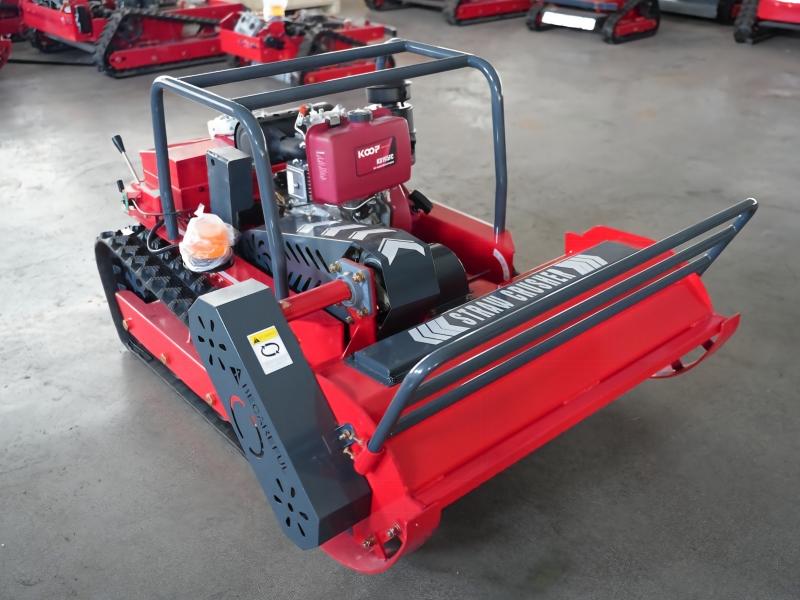
The equipment boasts a high degree of automation and collaboration in its overall operation. During operation, the power system continuously outputs energy to enable the synchronous operation of the cutting mechanism and the traveling mechanism. The crawler structure increases the grounding area and reduces the fuselage pressure, ensuring stable traveling on steep slopes, muddy roads and uneven ground. Operators can adjust the traveling speed and cutting height through a remote control or the body control system to adapt to different weeding requirements. Relying on the collaborative cooperation of the dual-channel transmission system, the machine realizes synchronous traveling movement and accurate mowing, and efficiently completes full-area weeding operations.